On Their Own Terms: How Indigenous Artists Are Rewriting the Visual Story of America
In her studio in Albuquerque, New Mexico, Diné painter Shanna Yazzie keeps a photograph pinned above her drafting table. It is not a reference image or an inspirational quote. It is a postcard reproduction of a nineteenth-century oil painting depicting a Native woman in a pose of melancholy stillness, wrapped in a blanket, gazing toward a horizon the viewer cannot see. Yazzie keeps it there deliberately.
"I look at it every morning before I start work," she says. "Not because I hate it, but because I want to remember exactly what I'm not doing."
What Yazzie is doing—along with a growing and increasingly visible cohort of Indigenous artists across the United States—is something far more complex, more personal, and more politically significant than correcting a historical record. She is building a new one.
The Weight of the Expected Image
For generations, the dominant visual representation of Indigenous peoples in American art was produced largely by non-Native artists working within a tradition of romantic primitivism. The images were often beautiful by the aesthetic standards of their time. They were also, by almost any honest measure, a fiction—a projection of settler longing for a vanishing world that was, in many cases, vanishing precisely because of settler action.
The consequences of that visual tradition extend well beyond art history. Those images shaped public perception, informed policy assumptions, and created a market expectation that persists in certain gallery circuits to this day: that authentic Indigenous art should look old, ceremonial, and elegiac. Work that does not conform to that expectation has historically struggled to find institutional support.
"There's still a segment of the collector market that wants turquoise and sunsets," says Jodi Archambault, a Hunkpapa Lakota artist and curator based in Minneapolis. "And there's nothing wrong with those aesthetic traditions when they're made by Native artists on Native terms. The problem is when the market decides that's the only thing we're allowed to make."
Bypassing the Traditional Gatekeepers
The most significant shift in Indigenous contemporary art over the past decade may not be stylistic at all. It is infrastructural. A generation of artists is building the systems that allow them to reach audiences without depending on institutions that have historically undervalued or misrepresented their work.
The Forge Project, based in Upstate New York, operates as both a residency and a collection dedicated exclusively to contemporary Indigenous art, with acquisition decisions made in close consultation with artists and tribal advisors. The Indigenous-led gallery Eiteljorg Museum Fellowship has for decades supported Native artists working in contemporary modes, providing both financial resources and curatorial legitimacy on their own terms.
Digital platforms have accelerated this independence considerably. Artists who once depended on gallery representation to access national and international collectors now maintain direct relationships with buyers through social media, artist-run websites, and curated online markets. The reach is imperfect and the economics remain challenging, but the autonomy is real.
"Instagram changed my life," says Mvskoke Creek artist Dyani White Hawk, whose geometric paintings draw on traditional beadwork aesthetics while engaging with the formal language of minimalism. "Not because it made me famous, but because it let me control my own narrative before someone else could define it for me."
Aesthetic Sovereignty in Practice
The work itself resists easy categorization, which is precisely the point. Cannupa Hanska Luger, a Mandan, Hidatsa, Arikara, and Lakota artist from North Dakota, creates large-scale ceramic installations that engage with contemporary political crises, including the Standing Rock protests, with formal sophistication and conceptual depth that places his practice squarely within the international contemporary art conversation—while remaining unmistakably grounded in Indigenous experience.
Roxanne Swentzell, a Santa Clara Pueblo sculptor, creates figurative ceramic work that draws directly on Pueblo artistic traditions while addressing contemporary themes of identity, community, and healing. Her work sells through institutional channels and through the Flowering Tree Permaculture Institute, a project she founded to support Indigenous food sovereignty—blurring the line between artistic practice and community infrastructure in ways that reflect a distinctly Indigenous understanding of what art is for.
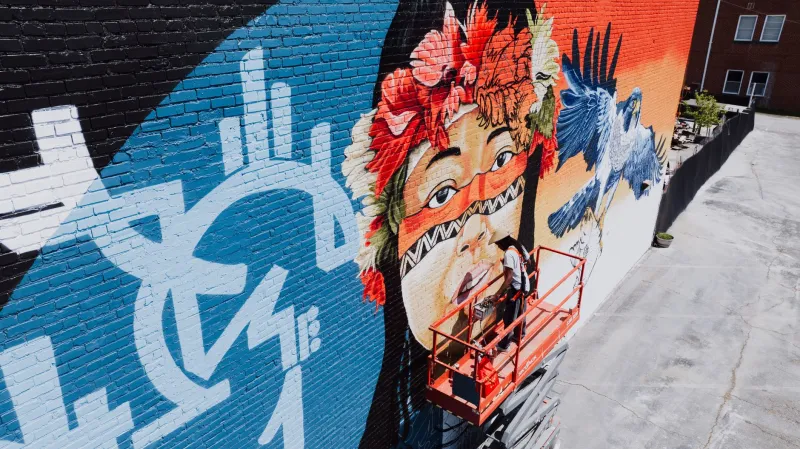
In the Pacific Northwest, Coast Salish artist lessLIE uses traditional formline design—a visual language developed over centuries and governed by specific cultural protocols—in ways that are simultaneously traditional and radically contemporary, appearing on digital prints, skateboard decks, and public murals. The work is not a translation of tradition into a modern idiom. It is a demonstration that the tradition was never static to begin with.
The Market Catches Up, Slowly
American art markets are beginning, if cautiously, to respond. Auction houses including Bonhams and Sotheby's have held dedicated sales of Indigenous contemporary art with results that surprised some observers. The National Museum of the American Indian in Washington, D.C. and New York continues to provide a vital institutional anchor, though artists are quick to note that a single institution, however excellent, cannot substitute for systemic inclusion across the broader museum landscape.
Major biennials and art fairs are increasingly featuring Indigenous artists—though advocates note that inclusion without meaningful curatorial context can reproduce the very exoticization it claims to overcome. The distinction between tokenism and genuine engagement is one that Indigenous artists and their allies are well-equipped to articulate.
"We don't need to be discovered," Archambault says simply. "We've been here. What we need is for the institutions to catch up to what we've already been building."
In Albuquerque, Yazzie sets down her coffee and turns back to her current canvas—a large-format acrylic work combining Diné weaving patterns with references to satellite imagery and digital data visualization. It is not what the postcard above her desk would have predicted. That is, she says, exactly the point.