Names in the Weeds: The Volunteers Charting America's Immigrant Burial Grounds
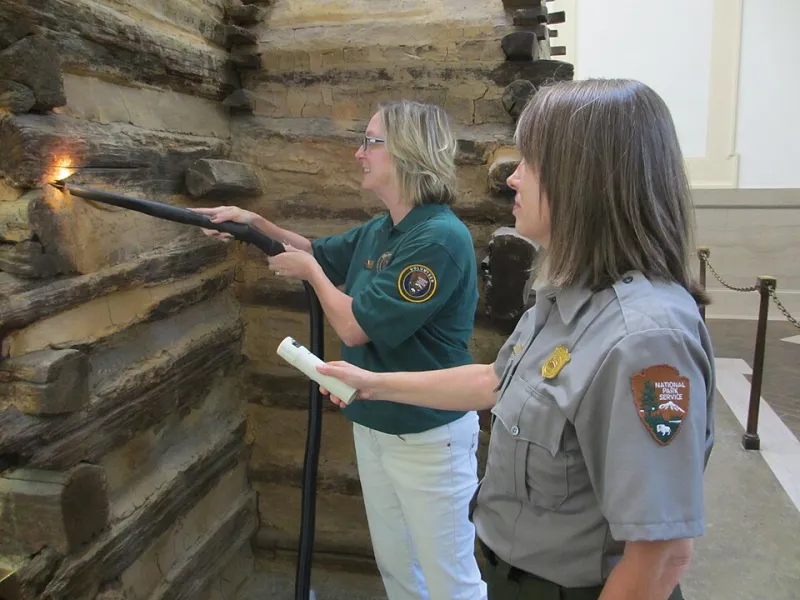
Photo: NPS, Public domain, via Wikimedia Commons
On a Saturday morning in a Pennsylvania churchyard, a half-dozen volunteers kneel beside headstones that have leaned for decades. They carry soft brushes, wooden scrapers, and jugs of water—not power washers. The work is slow because the material is fragile and the history is contested. These are immigrant graves, many marked in languages that local records never transcribed, and the volunteers have come to see the cemetery itself as a heritage site. Across the United States, similar brigades are forming in Texas, California, the Midwest, and the Northeast. They clean, repair, and map burial grounds that have slipped from municipal attention. In doing so, they expose a quiet question: what does it mean for a community to be remembered when the official map has moved on?
The Work Begins With a Soft Brush
Gravestone conservation is not restoration in the sense of making stone look new. Volunteers are trained to remove biological growth without scarifying the surface, to reset stones with appropriate backfill, and to document every intervention. The wrong technique can do more harm than decades of weather. In immigrant cemeteries, the work also involves translation. Hebrew, Arabic, Polish, Spanish, Chinese, Tagalog, and Vietnamese inscriptions may appear on stones that local historical societies cannot read. Volunteers recruit native speakers and compare inscriptions with family records, funeral home ledgers, and oral histories. The goal is not merely to clean a name but to restore a chain of interpretation.
Mapping the Unmapped
Many immigrant burial grounds were established by mutual aid societies, fraternal orders, and congregations that no longer exist. Their records may be scattered among families or stored in a church basement. Volunteers use GPS units, spreadsheets, and smartphone photographs to create public maps of grave locations. In one Texas cemetery, a volunteer team found that a section labeled 'unknown' on a county map contained dozens of identifiable markers in Spanish and Czech. The discovery did not solve the underlying neglect, but it gave descendants a way to find ancestors. Mapping is therefore more than technical work. It is a form of civic repair.
Municipal Neglect and the Question of Belonging
Cemeteries are often treated as private property or family responsibility until they become a public nuisance. Immigrant and working-class burial grounds are especially vulnerable to this pattern. When a congregation dissolves or a maintenance fund runs dry, the grounds can fall to volunteers or to no one. Municipal governments may mow the grass but lack the resources or mandate to conserve stone. The volunteers who step in are performing a service that sits awkwardly between charity and public heritage work. Their labor raises a question that extends beyond any one cemetery: why are some burial grounds treated as civic assets and others as orphaned ground?
When Restoration Is Not Enough
Cleaning a headstone can be satisfying, but volunteers are careful not to confuse visible progress with justice. A restored stone does not replace missing death records, untranslated inscriptions, or the absence of descendants who can care for a plot. Some brigades now pair conservation days with genealogy workshops and translation clinics. Others advocate for local governments to adopt abandoned cemeteries as heritage sites with maintenance budgets. The most effective groups resist the hero narrative. They describe their work as temporary stewardship and insist that the long-term answer is public recognition, not annual cleanups.
Memory as a Shared Obligation
For Thiqar Arts & Heritage, these cemeteries are not marginal sites. They are archives of migration, labor, faith, and community formation. The volunteers who brush away moss and photograph inscriptions are reading that archive in public. Their work is delicate, sometimes imperfect, and often unsung. But it makes a clear claim: a name in the weeds still belongs to the record. The question is whether the rest of us will treat that record as a shared obligation or as a seasonal project. The brigades have already answered. They show up with soft brushes and spreadsheets, and they ask the institutions that oversee the land to show up with something more durable.