Painted Into the Record: Public Artists Who Are Returning Erased Histories to American Streets
The history of any American city is, in some measure, a history of what has been chosen for remembrance and what has been allowed to fade. Official monuments, museum exhibitions, and civic plaques tend to reflect the priorities of those who held institutional authority at the time of their creation — which is to say, they frequently omit the experiences of communities that were marginalized, displaced, or simply ignored. For decades, artists working in public spaces have understood something that many institutions have been slower to acknowledge: the street is a democratic canvas, and the histories painted onto it belong to everyone who walks past.
The five artists profiled below represent a distinct and urgent current in contemporary American public art. Their work is not decorative. It is archival, argumentative, and deeply community-rooted. Each of them has chosen a specific erased or underrepresented regional history and brought it back into public view — not as nostalgia, but as an active and living conversation between the past and the present.
1. Asha Mwangi — Detroit, Michigan
Asha Mwangi grew up in Detroit's North End neighborhood, in a community that had been shaped in large part by the Great Migration — the movement of millions of Black Americans from the rural South to northern industrial cities between 1910 and 1970. Yet when she looked at the walls of her neighborhood, she saw almost nothing that reflected this history. "We were living inside a story that no one had thought to paint," she has said.
Mwangi's ongoing project, Northbound, consists of a series of large-scale murals installed across a six-block stretch of the North End. Each panel depicts a specific decade of the Great Migration's impact on Detroit, drawing from archival photographs, oral history recordings held at Wayne State University, and interviews with elderly residents. The visual language is deliberately layered — documentary realism in the faces, abstraction in the backgrounds — creating a sense that the past is simultaneously precise and expansive. The project has been funded in part through the Knight Foundation and has drawn significant attention from urban history scholars, though Mwangi is quick to note that her primary audience is the neighborhood itself.
2. Tomás Aguirre — San Antonio, Texas
In the neighborhoods surrounding San Antonio's West Side, Tomás Aguirre has spent the better part of a decade painting the history of Tejano labor activism — a history that has been largely absent from both Texas school curricula and mainstream cultural institutions. His murals document the organizing efforts of Mexican American farmworkers and factory employees throughout the early and mid-twentieth century, figures who fought for wages and dignity at considerable personal risk and who are almost entirely unknown outside their own communities.
Aguirre's approach is explicitly political. He does not shy away from depicting conflict, exploitation, or the faces of historical antagonists alongside those of the workers who resisted them. "History without tension is just decoration," he has stated in interviews. His work has occasionally generated controversy — one mural depicting a 1930s labor strike was challenged by the building's owner before community pressure secured its preservation. The episode itself became part of the mural's story, and Aguirre documented the dispute in a supplementary panel that now accompanies the original work.
3. Priya Chandrasekaran — Fremont, California
Fremont, California, is home to one of the largest Afghani diaspora communities in the United States, as well as substantial populations of Indian, Pakistani, and Filipino residents. Priya Chandrasekaran, a second-generation Indian American artist, has worked closely with multiple communities in Fremont to create murals that reflect the complex, layered histories of South and Southeast Asian immigration to the Bay Area — histories that predate the post-1965 immigration wave by several generations, including early Punjabi Sikh settlers who arrived in California at the turn of the twentieth century.
What distinguishes Chandrasekaran's practice is her emphasis on process. Before a single brushstroke is applied, she conducts months of community listening sessions, reviewing family photographs and inviting residents to contribute written memories that are then woven into the visual design. The resulting murals are genuinely collaborative documents, and she credits this methodology for their durability — both physically, because communities take ownership of their maintenance, and socially, because the works reflect a shared rather than an imposed narrative.
4. Marcus Thibodaux — New Orleans, Louisiana
New Orleans has no shortage of public art, but Marcus Thibodaux has argued for years that the city's celebrated visual culture frequently romanticizes Creole and jazz heritage in ways that obscure the economic and racial violence that produced it. His response has been a series of murals in the Tremé neighborhood — widely regarded as the oldest African American neighborhood in the United States — that place the community's history of resistance and self-determination at the center of the frame.
One of his most discussed works depicts the 1900 Robert Charles uprising, an event in which a Black New Orleans man defended himself against police violence and sparked a broader confrontation that has been largely written out of mainstream Louisiana history. Thibodaux painted the mural on the side of a building one block from the site of the original events, a geographic precision that he considers essential. "The place matters," he says. "History has an address."
5. Elena Whitehorse — Albuquerque, New Mexico
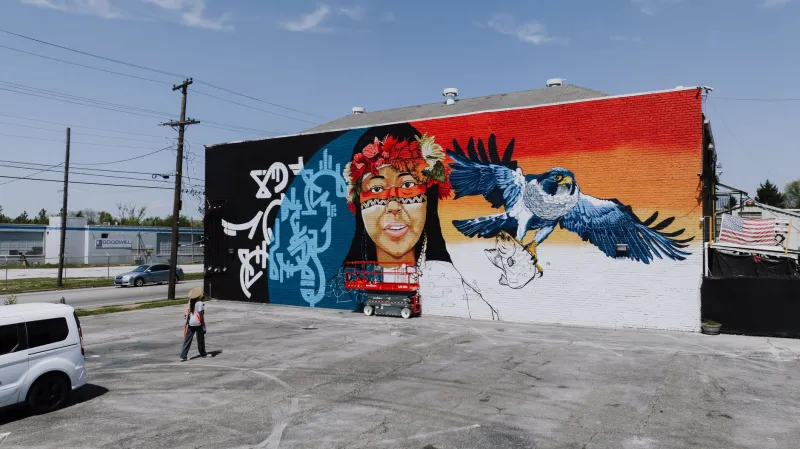
Elena Whitehorse is a Diné (Navajo) artist whose public work in Albuquerque's South Broadway neighborhood engages directly with the history of Indigenous displacement and urban relocation — specifically the federal Relocation Act of 1956, which encouraged Native Americans to leave reservations for urban centers while providing minimal support for the transition. The result was the growth of urban Indigenous communities in cities including Albuquerque, Chicago, and Los Angeles, communities whose experiences have remained largely invisible in both Indigenous and mainstream American cultural narratives.
Whitehorse's murals use traditional Diné visual motifs in conversation with the urban landscape, creating works that refuse to treat Indigenous identity as purely historical or rural. Her most recent installation, completed in partnership with the Albuquerque Indian Center, spans an entire city block and has become a gathering point for the community it depicts.
Art as Archive, Wall as Institution
What unites these five artists is not a shared aesthetic but a shared conviction: that heritage belongs to the communities that lived it, and that the walls of those communities are a legitimate — perhaps the most legitimate — place for that heritage to be held. In an era when the accessibility of cultural institutions remains uneven and the politics of historical representation continue to be fiercely contested, public art offers something that no museum can fully replicate: a history that is impossible to walk past without encountering.