Sanctuary, Rehearsed: Seven Congregations That Made Room for the Arts
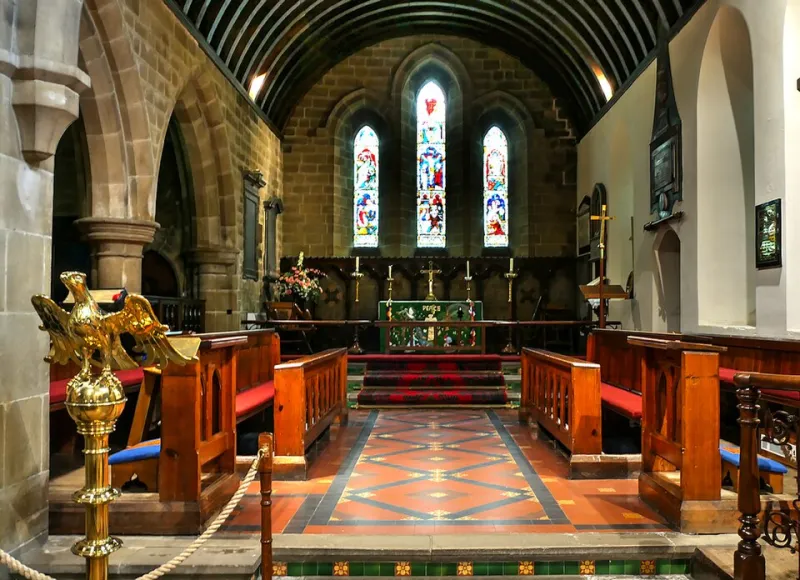
Photo: David Dixon , CC BY-SA 2.0, via Wikimedia Commons
On a Wednesday evening in late October, the fellowship hall of a Baptist church on Chicago's South Side held two things at once: a folding table of casseroles and a jazz quintet running a sound check. By seven o'clock the table was gone, the chairs were in rows, and roughly eighty neighbors were listening to a saxophonist who had learned to play in that same room two decades earlier.
Scenes like this are not unusual. They are simply unrecorded. Faith buildings have always been among the most generous pieces of civic infrastructure in the United States, and a quiet share of the country's theater, dance, and music happens under steeples, minarets, and meetinghouse roofs. What has changed in recent years is the degree of intentionality: some congregations now write arts partnerships into their mission statements, while others arrive at the arrangement through a rental agreement and a stack of liability forms.
Seven rooms, seven arrangements
1. The sanctuary that doubles as a concert hall. A 1912 Lutheran church in an older Cleveland neighborhood hosts a chamber music series on Saturday nights. The pews stay put. The altar guild learned to work around a piano tuner's schedule, and the series pays a sexton for the extra hours. Ticket revenue covers the fee; the congregation covers the heat.
2. The basement dance floor. A Pentecostal congregation in Houston's East End laid a sprung floor over old tile so a youth folklórico troupe could rehearse without injuring ankles. The group pays a modest monthly fee, but the real negotiation was over Sunday morning: nothing stays on the floor past Saturday night.
3. The parlor language circle. A Quaker meetinghouse in Philadelphia opens its parlor twice weekly to conversation circles in Vietnamese and Arabic. No fees change hands. The arrangement is treated as an extension of the meeting's peace testimony, and the only friction has been over the thermostat.
4. The multipurpose room as screening room. A mosque in Dearborn, Michigan, converts its multipurpose hall into a film venue four times a year, showing documentaries on Arab American history. Chairs are borrowed from the adjacent school. Attendance has outpaced the room's parking.
5. The rural church turned print shop. A small Methodist congregation in central Iowa, down to thirty regular attenders, repurposed its education wing as a letterpress studio and community darkroom. The building's heat bill is now shared with a local arts council, which treats the space as a satellite classroom.
6. The church that hosts a jazz workshop. On Tuesday nights, a Black church on Chicago's South Side becomes a rehearsal room for an intergenerational jazz workshop. Elders sit in with teenagers. The pastor describes the arrangement as a continuation of the church's music ministry rather than a rental.
7. The synagogue social hall as chorus rehearsal space. A Baltimore congregation rents its social hall to a ninety-voice community chorus on Monday nights. The lease is one page. The disagreements are about storage: risers, music stands, and a decades-old set of holiday decorations competing for the same closet.
Where the friction actually lives
The popular assumption is that conflict between congregations and arts groups revolves around money. In practice, money is often the easiest part. The harder negotiations involve sound, scheduling, and symbols.
Sound is the most predictable. Congregations with aging members receive complaints about bass frequencies that travel through stone. A theater troupe in Kentucky, rehearsing a musical in a church hall, was asked to strike drums before the Wednesday evening prayer service. It complied, and the compromise produced a rehearsal schedule that now runs eleven months a year.
Scheduling is the second pressure point. Houses of worship are not empty buildings; they host funerals, food pantries, quinceañeras, and recovery meetings. An arts partner that treats the calendar as a blank grid will discover otherwise within a month.
Symbols are the least discussed and most delicate. A dance company rehearsing in a sanctuary may want to hang fabric or place a set piece where the congregation does not expect it. A film series may prefer dim lighting that makes the room feel unlike itself. These are not trivial objections. A room that carries a community's grief and ritual is not a neutral black box, and the groups that thrive tend to treat that fact as a design constraint rather than an inconvenience.
The paperwork of hospitality
Almost every thriving partnership shares a few administrative habits. Insurance certificates are exchanged up front. A single staff member on each side is named as the contact. A written calendar exists and is honored. Some congregations establish a small arts committee so that decisions do not rest entirely on the pastor or the building manager, who already carry enough.
A smaller number go further, building a joint use agreement that specifies who pays for utilities during evening hours, who holds keys, and what happens when a funeral displaces a rehearsal. These documents are unglamorous, and they are the difference between a partnership that lasts a decade and one that ends after a season.
What the congregation receives
It would be condescending to frame these arrangements purely as charity. Congregations that open their doors report concrete returns: rental income that offsets deferred maintenance, new volunteers for food ministries, and, most frequently, younger faces in the building on days other than Sunday.
Several pastors described a subtler benefit. A sanctuary that hosts a concert, a funeral, and a language class in the same week stops functioning as a museum of its own past. It becomes a room people expect to enter.
The question left open
The unresolved question is not whether faith spaces should host the arts. They already do. It is whether the arrangement is treated as an exception or as a stated purpose. A congregation that decides, in writing and in budget, that its building serves the neighborhood's cultural life will make different choices about the roof, the calendar, and the chairs.
The music in the fellowship hall ends at nine. Someone stacks the last chair. Someone else turns off the lights. The room returns to being what it was, which is to say, it never really stopped being that.