Whose Plaza Is It Anyway? The Battle Over Public Space and the Right to Cultural Belonging
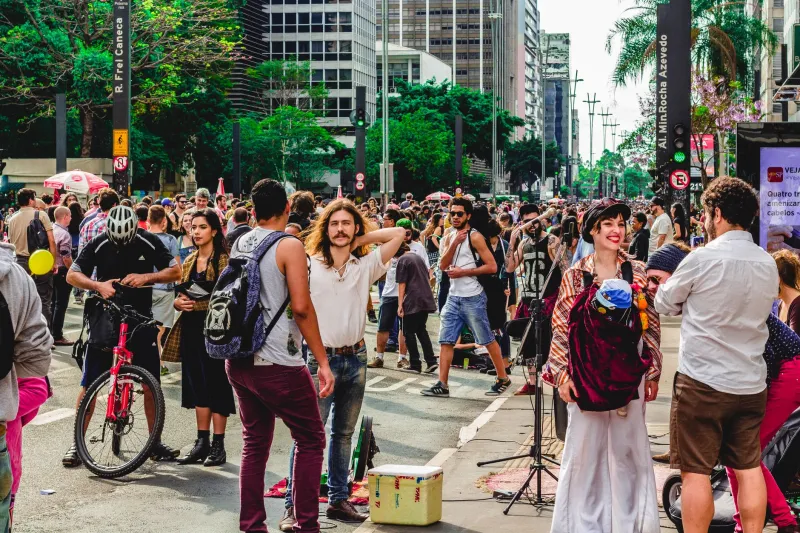
There is a particular kind of tension that arises when a city government and a neighborhood community look at the same stretch of pavement and see entirely different things. The city sees a managed public asset — a resource to be maintained, permitted, and regulated. The neighborhood sees something older and less legible to bureaucratic language: a place where life has always happened, where grief is expressed, where identity is performed, where belonging is claimed.
This tension is playing out in cities across the United States with increasing visibility, and it raises questions that go far beyond park management or event permitting. At its core, the contest over public space is a contest over cultural authority — over who has the right to determine what a community's shared life looks like.
The Permit and the Procession
In many American cities, the formal process for using public space is not designed with cultural spontaneity in mind. Permit applications, liability insurance requirements, noise ordinances, and timeline restrictions reflect a bureaucratic logic that presupposes planned, bounded events with identifiable organizers. This framework fits a corporate street fair reasonably well. It fits a Día de los Muertos procession, a West African drum circle, or an impromptu community memorial considerably less comfortably.
The friction is not always a matter of bad faith on the part of city planners. In many cases, regulations were written without meaningful input from the communities they now govern. The result is a structural mismatch between official frameworks and the organic rhythms of cultural life — one that disproportionately affects communities of color, immigrant populations, and working-class neighborhoods whose cultural practices were never considered in the original design.
In Houston, advocates for Vietnamese-American community celebrations in the city's Midtown district have spent years negotiating with municipal departments over the terms under which traditional Tết festivities can occupy public streets. The celebrations, which draw tens of thousands of participants, predate several of the city's current permitting structures. Yet each year, organizers must navigate a process that treats their centuries-old tradition as a new and potentially disruptive occurrence.
Gardens as Declarations
If street festivals represent cultural reclamation through celebration, community gardens represent it through sustained, daily presence. In New York City, the community garden movement — particularly in the South Bronx and East Harlem — has long functioned as more than horticulture. These plots of cultivated earth are assertions of neighborhood permanence in the face of displacement pressure, and they frequently carry explicit cultural significance.
Many gardens in predominantly Puerto Rican and Dominican neighborhoods incorporate casitas — small, brightly painted structures modeled on traditional Caribbean architecture — alongside plantings of herbs and vegetables that hold medicinal and culinary meaning within those communities. The gardens are simultaneously food sources, gathering places, and living museums of diasporic heritage.
Yet these spaces have faced recurring threats from city redevelopment priorities. The battles over New York's community gardens in the late 1990s and early 2000s — when the Giuliani administration moved to auction hundreds of garden lots to developers — became landmark conflicts in the history of urban cultural rights. Though many gardens were ultimately preserved through advocacy and philanthropic purchase, the underlying tension between community use and official planning authority has never fully resolved.
Memorials and the Grammar of Grief
Few expressions of cultural reclamation are as emotionally charged — or as legally ambiguous — as the spontaneous memorial. When a community member dies, particularly in circumstances involving violence or injustice, the immediate human impulse to mark the site of loss frequently collides with municipal regulations governing what may be placed on public property and for how long.
In South Los Angeles, community organizations have developed informal protocols for maintaining roadside and sidewalk memorials that would otherwise be removed by city crews. Photographs, candles, flowers, and handwritten messages accumulate at these sites in ways that defy easy categorization — they are neither permitted installations nor simple litter, but rather complex expressions of communal mourning that carry cultural weight.
Scholars of public space have noted that the treatment of informal memorials by municipal authorities often functions as an inadvertent signal about whose grief is considered legitimate and whose expressions of loss are deemed worthy of accommodation. The removal of a memorial — even when legally justified — can communicate something profound and damaging about a community's standing in the city's moral geography.
Reclamation Through Festivity
Not all contestation is confrontational. Some of the most effective acts of cultural reclamation in public space operate through the disarming medium of celebration. Street festivals, in particular, have long served as mechanisms by which communities assert presence, visibility, and belonging in ways that are simultaneously joyful and politically legible.
In Minneapolis, the Somali community's annual celebration in Brian Coyle Community Center's adjacent park has grown from a small neighborhood gathering into one of the city's most attended cultural events. The festival's expansion has required ongoing negotiation with parks department officials, but it has also generated sufficient civic goodwill to make those negotiations increasingly productive. Cultural visibility, organizers have found, creates political capital.
In Atlanta, similar dynamics have played out around the growth of West African cultural festivals in Piedmont Park, where community organizers have leveraged public enthusiasm and media attention to secure more favorable terms from city officials who might otherwise have prioritized other uses of the space.
The Design Question
Beyond the politics of use and permission lies a deeper question about the physical design of public space itself. Urban planners and architects have increasingly recognized that the built environment of public squares, plazas, and parks encodes assumptions about who those spaces are meant to serve. Seating arrangements, lighting choices, the placement of vendors and restrooms, the acoustic properties of a space — all of these reflect decisions made by designers working within particular cultural frameworks.
A growing movement within urban design is pushing for community-participatory planning processes that bring residents into design decisions before concrete is poured rather than after. In several cities, pilot programs have engaged neighborhood residents — including youth, elderly community members, and recent immigrants — in visioning exercises that surface cultural needs and preferences that would not emerge from standard planning surveys.
The results have been instructive. Communities have requested covered gathering spaces suited to extended outdoor socializing, cooking areas that accommodate communal food preparation, and flexible surfaces that can support both children's play and adult ceremony. These are not unreasonable requests. They are simply requests that the standard planning toolkit was not designed to receive.
A Civic Argument
The communities asserting cultural authority over public space are not, in most cases, arguing against shared use or civic order. They are arguing for a more honest accounting of whose needs and whose traditions have historically shaped — and been excluded from — the management of shared life.
That argument, at its most fundamental, is an argument about democracy. Public space is, by definition, held in common. What communities across America are insisting upon is that "common" mean something more than the preferences of those with the greatest institutional access. It must mean something capacious enough to hold the drum circle and the permit application, the casita and the zoning code, the spontaneous memorial and the city maintenance schedule — all at once, in the same complicated, contested, genuinely shared plaza.